9 Top AI Autoblogging Tools for Long-Form SEO Articles
You need 50 long-form articles a month, and your current tool is producing thin drafts that do not rank. Some platforms changed their pricing, others cap output, and editing every paragraph yourself defeats the purpose of autoblogging. That is why bloggers and agencies are testing alternatives right now.
This article breaks down nine AI autoblogging tools built for long-form SEO content, starting with Autoblogging.ai as our top overall pick. You will get the exact criteria to compare them on: output volume, SEO features, and real cost per article. By the end, you will know which tool fits your workflow and which one to skip.
What to Look For in AI Autoblogging Tools for Long-Form SEO Articles
When evaluating AI autoblogging tools for long-form SEO articles, focus on five critical capabilities: content depth, SEO integration, output volume, customization, and pricing scalability. Each one shapes whether a tool can support a serious blog automation strategy or only produce thin, surface-level posts.
The strongest platforms combine natural language processing and machine learning with large language models such as GPT-4 or comparable systems. That combination is what allows automated content generation to move beyond generic filler and toward articles that read like a human wrote them.
Content depth is the first filter. A tool built for long-form SEO articles should reliably produce pieces of 2,000 words or more, with logical flow from introduction to conclusion. Watch for factual accuracy too: models that hallucinate statistics or misstate basic facts create editing work that cancels out the time saved. Tools that structure output around an outline, then expand each section, tend to hold coherence better than those that generate one continuous block of text.
SEO integration separates a writing assistant from a true SEO tool. Look for built-in keyword research, SERP analysis, and semantic SEO features such as latent semantic indexing, entity extraction, and topic clustering. Readability scoring matters as well, since search engines and readers both reward clear prose. Some platforms also generate content briefs or support pillar pages, which helps when mapping a full site architecture rather than isolated posts.
Output volume determines how far a tool scales. Casual bloggers may only need a handful of articles per month, while agencies and affiliate site operators often need bulk content creation in the range of 10 to 500 articles monthly. Check whether bulk generation runs through a queue, a CSV upload, or an API, since manual one-by-one generation rarely keeps pace with a real publishing calendar.
Customization covers tone of voice, content templates, and integrations. A tool should let you define a brand voice, reuse templates for recurring formats like listicles or product reviews, and connect through API integration or a WordPress plugin for direct publishing. Without these options, every article needs manual reformatting before it goes live.
Pricing scalability deserves close attention because plans vary widely in structure. Credit-based pricing ties cost directly to usage, which suits occasional publishing, while unlimited plans favor high-volume operations. Compare rollover policies carefully: unused credits that expire monthly can quietly raise your effective cost per article.
A quick comparison of what to check:
- Depth: 2,000+ word output, logical structure, factual reliability
- SEO: keyword research, SERP analysis, semantic SEO, readability score
- Volume: bulk content creation supporting 10 to 500 articles per month
- Customization: tone of voice, content templates, API and WordPress access
- Pricing: credit versus unlimited models, plus rollover terms
Tools such as Jasper AI, Copy.ai, Writesonic, Article Forge, ContentBot, Rytr, Simplified, and Neuroflash each approach these criteria differently, and most are strongest in one or two areas rather than all five. Some lean toward marketing copy, others toward bulk generation or multilingual output. The right fit depends on whether your priority is a versatile AI writing assistant or a dedicated engine for automated content generation at scale.
Weigh the five criteria against your actual publishing goals rather than a feature checklist. A solo blogger publishing twice a week has different needs than an agency managing dozens of client sites. Matching the tool to the workflow prevents paying for capacity you will never use, or outgrowing a plan within a few months.
1. Autoblogging.ai - Best Overall
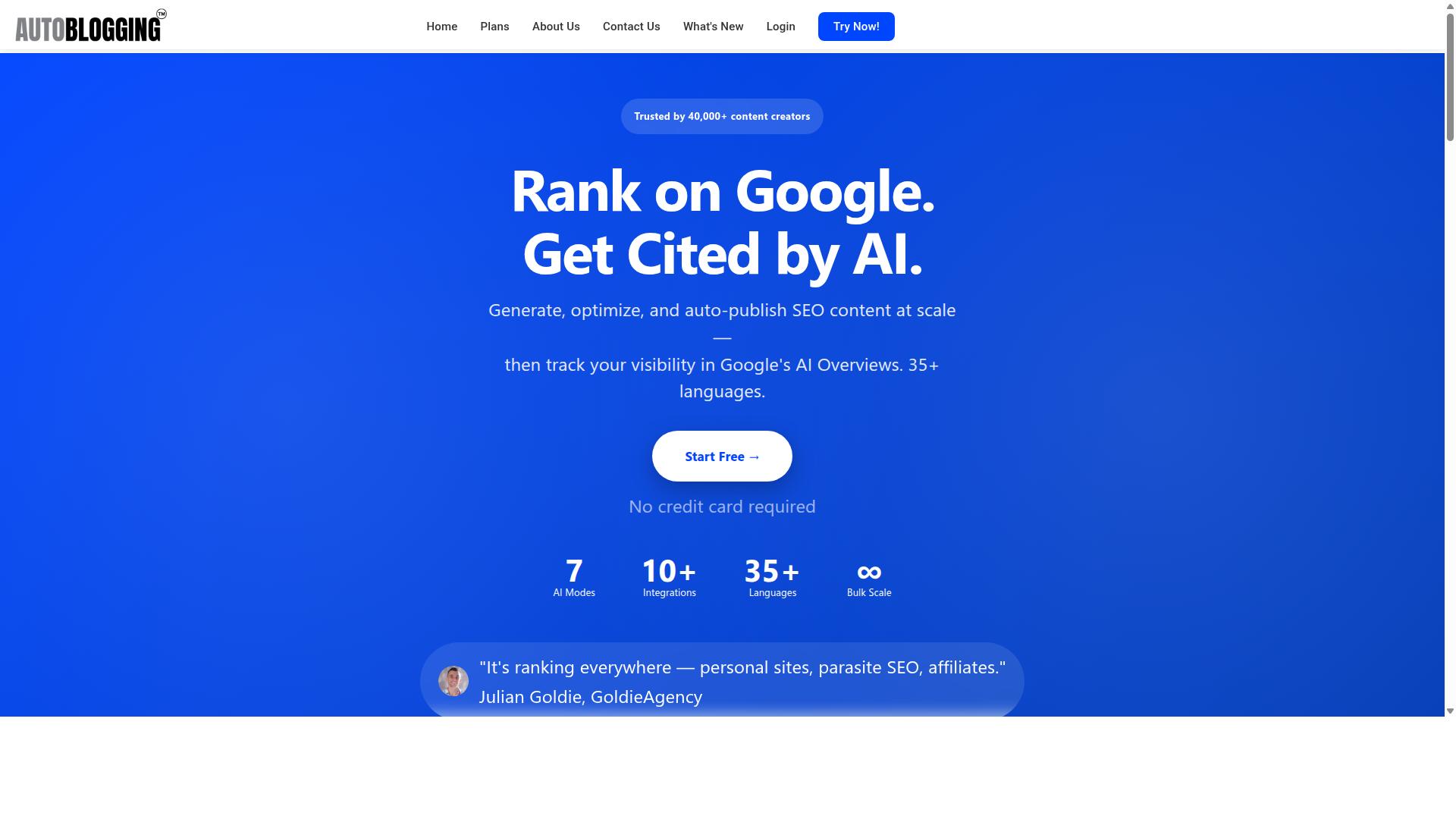
Autoblogging.ai stands out as the best overall AI autoblogging tool for long-form SEO articles, trusted by over 40,000 content creators and generating more than 1 million articles. It carries a 4.9 average rating and combines a deep feature set with pricing that scales from solo bloggers to large agencies.
What separates it from most AI autoblogging tools is breadth. You get 10+ AI modes, support for 35+ languages, and 35+ integrations, all under one roof. Credits roll over instead of expiring, and new features ship weekly.
The platform suits bloggers, agencies, and affiliate marketers who need consistent output without sacrificing SEO quality. A human proofreader is included in every plan, and one-click WordPress publishing keeps the workflow tight.
For anyone comparing AI autoblogging tools for long-form SEO articles, Autoblogging.ai sets the benchmark on both capability and value. The details below explain why.
Key Features, Pricing, and Who It's Best For
Autoblogging.ai offers a robust set of features including Quick Mode for free single articles, Godlike Mode for deep SERP competitor analysis and LSI keyword extraction, and Bulk Generation for up to 500 articles at once. Each mode targets a different stage of the content workflow.
Quick Mode covers free single articles and a wizard option, which makes it easy to test the platform before committing. Godlike Mode goes further with SERP competitor analysis, LSI keywords, and knowledge graph extraction for semantically rich drafts.
Bulk Generation handles up to 500 articles via CSV, a fit for agencies and affiliate marketers managing multiple sites. Publishing runs through WordPress integration and an API, alongside 35+ other integrations.
Beyond generation, the platform includes a 21-point SEO audit, featured snippet optimization, and a human proofreader on all plans. These tools support SEO optimization and search engine ranking goals rather than leaving them to guesswork.
| Plan | Price | Credits |
|---|---|---|
| Starter | $19 | 40 credits |
| Regular | $49 | 120 credits |
| Standard | $99 | 300 credits |
| Gold | $179 | 600 credits |
| Premium | $249 | 1,000 credits |
| Enterprise | $999 | 5,000 credits |
Annual plans are available, and unused credits roll over, which reduces waste for teams with uneven publishing schedules. Support runs 24/7, and new features ship weekly.
The target audience spans bloggers, website owners, SEO professionals, marketing agencies, content creators, and affiliate marketers. It is best for those needing high-volume, SEO-optimized long-form content with advanced customization.
2. Agility Writer
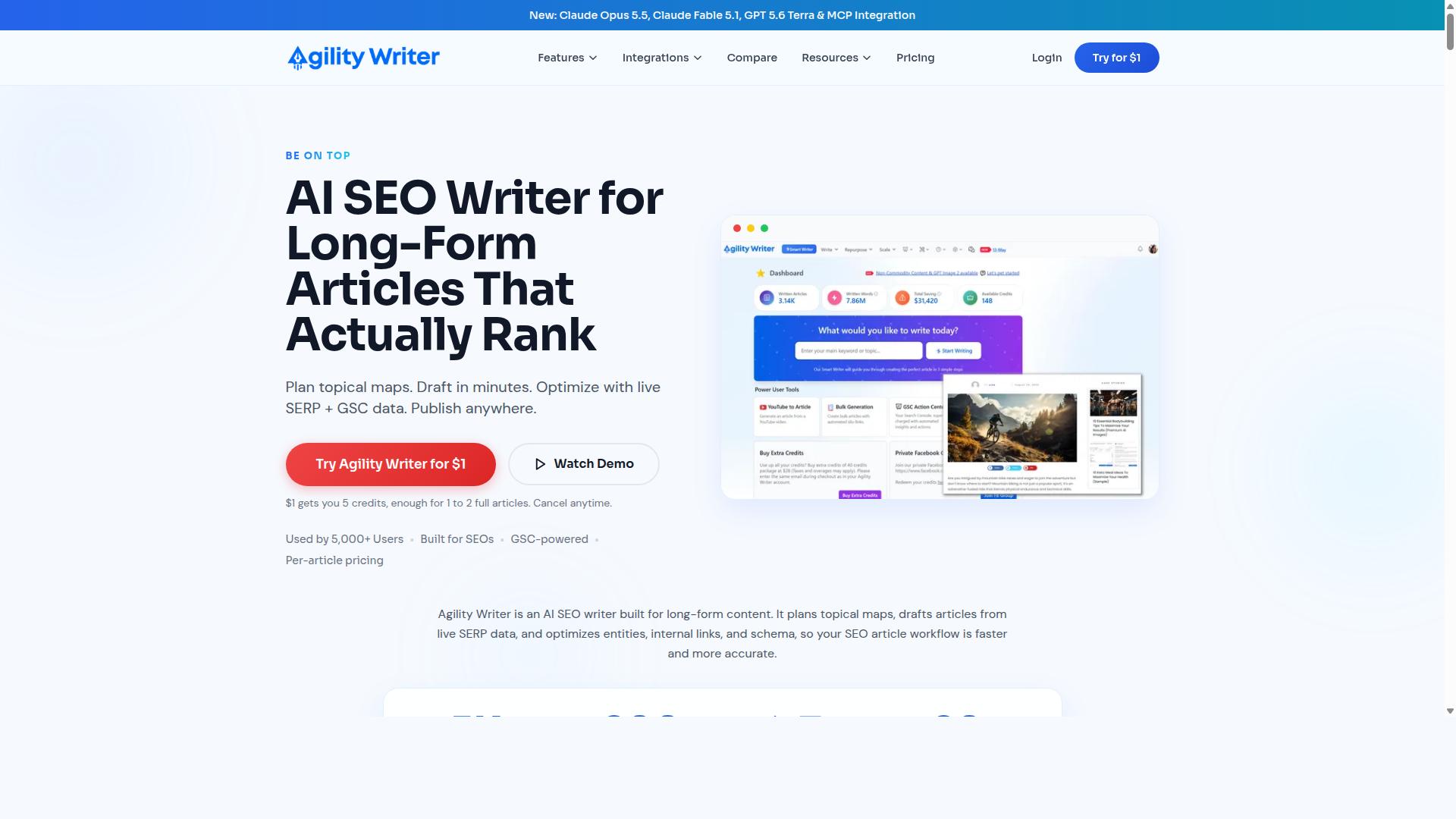
Agility Writer is a versatile AI writing tool that excels at generating long-form SEO articles with a focus on readability and keyword optimization. It is built primarily for SEO-focused content creators and affiliate marketers who need factual, search-ready drafts at scale.
The tool leans heavily on live SERP data when drafting, which helps align output with what currently ranks. It also positions itself around Google's Helpful Content Update, so the emphasis is on useful, people-first articles rather than thin keyword stuffing.
Its feature set covers the full content workflow, from planning to publishing. Notable capabilities include:
- Bulk Generation for producing multiple articles in a single run
- Templates and Writing Modes for blog posts, product reviews, and roundup reviews
- Smart Writer, Smart Editor, and Smart Visual AI for drafting, refining, and adding visuals
- Fact Sheets to keep generated content grounded in source material
- GSC Action Center and G-Smart Optimizer for search performance insights
- Topical Authority Audit and topical map planning for topic clustering
- Social Posts for repurposing content beyond the blog
- MCP Connector plus integrations with Claude, ChatGPT, Cursor, WordPress, API, and Zapier
The pricing entry point is a $1 trial with 3 credits for 3 articles. There is no free trial beyond that, so users get a low-cost way to test output quality before committing further.
Compared with Autoblogging.ai, Agility Writer is strong on SERP-driven drafting and workflow extras like the GSC Action Center. Its limitations show up in the trial structure, which caps how much you can evaluate before paying, and in a feature list that can feel broad rather than focused. Autoblogging.ai, by contrast, is positioned as the more streamlined option for automated content generation, and its verified details are outlined in its own entry above.
For teams already running an SEO content marketing operation, Agility Writer is a credible pick. For those who want simpler blog automation with fewer moving parts, the trade-offs are worth weighing.
3. SEOWriting.ai
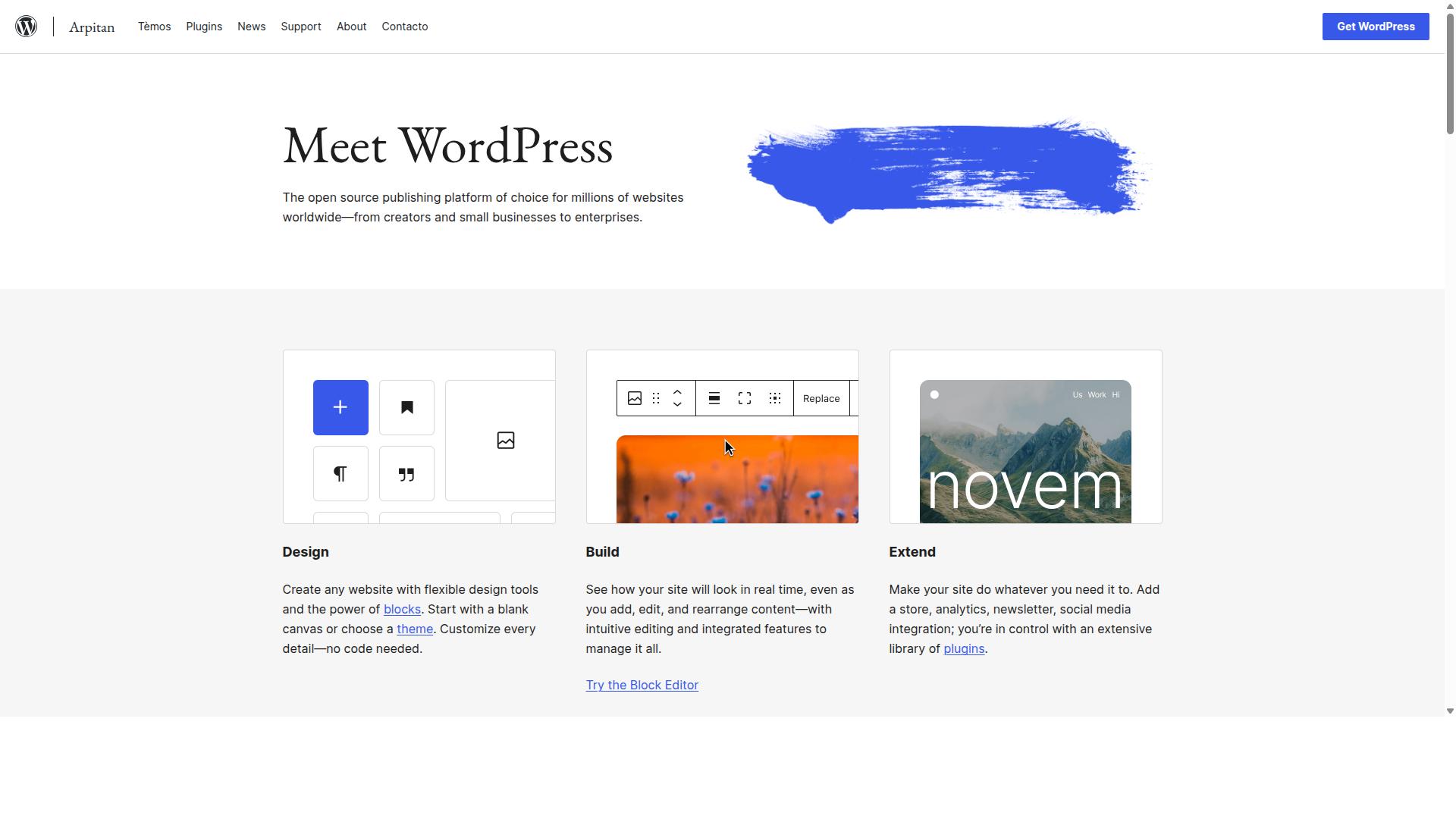
SEOWriting.ai is designed for SEO professionals, offering automated generation of long-form articles with integrated keyword research and SERP analysis. It leans heavily into the workflow that content marketers and affiliate publishers deal with every day: pick a keyword, review what already ranks, and produce a draft that fits the intent behind the query.
Its standout feature is one-click article generation paired with auto-posting. Rather than treating drafting and publishing as separate steps, the tool is built to move a finished piece straight into a live site. For teams running bulk content creation across multiple properties, that shortcut removes a meaningful amount of manual copying and formatting.
WordPress integration sits at the center of the product. Articles can be pushed to a connected site without exporting files or rebuilding layouts by hand, which matters when the goal is consistent publishing volume rather than one-off pieces. The platform also bundles SEO-oriented tooling, including keyword research and SERP analysis, so the brief and the draft come from the same place.
On pricing, SEOWriting.ai uses a freemium entry point. Its free plan offers 3 free articles (up to 25,000 words), which is enough to judge output quality before committing. Paid tiers scale from there, and the tool has been listed among the 7 best SEO writing AI free platforms for 2026.
Its target audience is fairly narrow and clear:
- SEO professionals producing content at scale
- Affiliate and niche site publishers managing several blogs
- Agencies handling bulk article orders for clients
- Marketers who want keyword research and drafting in one interface
Compared with Autoblogging.ai, the two overlap on the fundamentals: automated content generation, WordPress publishing, and SEO optimization aimed at search engine ranking. The practical difference tends to show up in emphasis. SEOWriting.ai foregrounds the one-click draft and the free trial allowance, while Autoblogging.ai is positioned around blog automation as an ongoing publishing system rather than a single-article tool.
Output volume is where buyers should ask careful questions. Both tools support bulk content creation, but the real constraint is usually not how many articles can be generated. It is how many can be edited, fact-checked, and published without diluting quality. A free plan like the one SEOWriting.ai offers is useful for testing whether the raw output needs light editing or heavy rewriting.
For long-form SEO articles specifically, look at how each tool handles structure. Long pieces benefit from topic clustering, clear heading hierarchy, and coverage of related entities rather than a single keyword repeated throughout. Tools that support content briefs and semantic SEO signals generally produce drafts that need less restructuring later.
Practical advice: run the same keyword through both platforms and compare the drafts side by side. Check readability, factual accuracy, internal linking potential, and how much of the structure survives untouched. That comparison tells you more about fit than any feature list, because the right choice depends on your editing capacity and publishing cadence.
4. Koala AI

Koala AI is a user-friendly AI content generator that simplifies the creation of long-form SEO articles for bloggers and small businesses. It bundles two main components: Koala Writer, an SEO-focused writing tool, and Koala Chat, a supporting chatbot.
The platform leans heavily on one-click article generation. Users enter a topic or keyword, and the tool produces a publish-ready draft that is already shaped around SEO best practices. That makes it appealing to anyone who wants to move from idea to draft with minimal friction.
Koala AI also supports Amazon affiliate articles, a niche that many general-purpose AI writers handle poorly. For niche site publishers who monetize through affiliate links, that focus can be a meaningful advantage.
Core Features
Beyond one-click generation, Koala AI offers several options that give writers more control over the final output:
- Tone-of-voice settings to match a brand or publication style
- Custom outlines so users can steer structure before drafting
- Google Sheets integration for managing batches of articles
- Koala Chat for conversational assistance alongside the writer
The custom outline feature matters for long-form SEO articles, where structure often determines whether a piece ranks. Being able to define headings and subtopics upfront keeps the automated content generation aligned with search intent.
That said, the interface is described as basic, and the chatbot is fairly basic compared to the writer. Users who expect a polished all-in-one workspace may find the experience lean.
Pricing and Who It Is Best For
Koala AI positions itself as an affordable entry point. Public materials state that prices start at $9, described as "effectively a no-brainer," and the platform offers "GET 5000 WORDS FREE" as a trial. Those terms make it easy to test before committing.
The tool suits SEOs and niche site publishers in particular. Freelancers producing affiliate content and small businesses building topical blogs are also a natural fit.
Compared with a broader AI autoblogging platform, Koala AI appears more focused on the writing step itself. Autoblogging.ai, by contrast, is positioned around end-to-end blog automation, so the two may appeal to different workflows. Which one fits better likely depends on whether you want a dedicated writer or a fuller publishing pipeline.
On output quality, Koala AI can produce solid drafts, though results may still need editing for accuracy and depth. On scalability, Google Sheets integration helps with bulk content creation, but heavy volume users may want to check word limits and plan tiers carefully.
5. Content at Scale

Content at Scale specializes in producing human-quality, long-form SEO articles at scale, leveraging advanced AI models. It is one of several platforms positioned for teams that need to publish frequently without losing readability.
Its core appeal is bulk production of long-form content. Rather than generating short drafts that need heavy expansion, the tool aims to deliver article-length output that reads naturally and follows a clear structure.
SEO optimization sits at the center of its workflow. Writers can target keywords, shape briefs, and steer output toward search intent before publishing through common content management systems.
Based on publicly available information, Content at Scale also appears in comparisons of tools that support research and citation workflows. Those roundups typically evaluate features such as SERP-based competitor analysis, adjustable citation styles, and export options.
Pricing details vary and should be checked directly on the vendor's site, since plans and limits change over time. What matters more is whether the volume and quality match your publishing cadence.
The platform is often discussed as a fit for agencies and large content operations. Teams managing multiple client sites or high-volume blogs tend to value throughput, while smaller publishers may find the output exceeds their needs.
Compared with Autoblogging.ai, the two take different paths. Content at Scale leans toward long-form generation at volume, while Autoblogging.ai emphasizes automated content generation for ongoing blog publishing. Reviewers weighing both should look at editorial control, output consistency, and how each tool fits an existing workflow.
- Strong fit for high-volume publishing schedules
- Long-form output intended to read naturally
- SEO-focused briefs and keyword targeting
- Commonly grouped with research and citation tools
- Worth comparing on editorial control and workflow fit
For buyers, the practical test is simple. Generate a sample article on a topic you know well, then judge structure, accuracy, and how much editing it needs before it goes live.
6. Article Forge

Article Forge is a veteran AI writing tool known for its ability to automatically generate unique, SEO-friendly articles on any topic. It has been part of the automated content generation space for years, which gives it a level of name recognition among bloggers and content marketers.
Its core function is straightforward: you supply a keyword or topic, and the tool produces a complete article without manual drafting. This makes it a familiar option for anyone exploring AI autoblogging tools for the first time.
Article Forge is typically positioned as a hands-off solution. Rather than guiding you through outlines or briefs, it aims to deliver finished drafts in a single pass, which appeals to users who want speed over granular control.
Core Functionality
The platform centers on automatic article generation. A user enters a topic, and the system builds a full-length piece using natural language processing and machine learning models. The output is intended to read as a coherent article rather than a collection of disconnected paragraphs.
Because it is designed for volume, Article Forge is often used for bulk content creation. Marketers managing multiple sites may find this useful when they need drafts at scale rather than a single polished piece.
That said, the depth of each article can vary. Topics that require nuance, original insight, or subject-matter expertise may come out thinner than expected, and most users treat the output as a starting draft rather than a final product.
SEO Features
Article Forge includes basic SEO optimization aimed at helping content rank. Users can target keywords, and the tool attempts to weave them naturally into headings and body text. It also supports internal linking, which can help with site structure and search engine ranking.
These features cover the fundamentals of on-page SEO. They do not replace deeper work like keyword research, SERP analysis, or semantic SEO planning, so most teams pair the tool with separate optimization workflows.
For long-form SEO articles, the built-in controls are relatively light. There is limited support for advanced tactics such as entity extraction, topic clustering, or pillar page structuring, which are increasingly important for competitive niches.
Pricing
Article Forge generally uses a subscription model, with plans that scale based on usage. Pricing details change over time, so it is worth checking the official site for current rates rather than relying on older reviews.
Compared with some competitors, the entry point tends to be accessible for solo bloggers, while higher tiers target agencies and teams that need more volume. Buyers should weigh cost against how much editing the drafts require.
Strengths and Limitations
Article Forge has clear strengths that keep it in the conversation among AI autoblogging tools:
- Uniqueness: It is built to produce original text rather than scraped or duplicated content.
- Speed: Full articles can be generated quickly, which supports bulk content creation.
- Simplicity: The workflow is minimal, making it easy for beginners to use.
- Automation: It can run with little human input, which suits high-volume publishing.
The limitations are worth noting too. Depth is the most common complaint, since generated pieces can feel generic on complex subjects. Customization is also limited compared with tools that let you define tone of voice, content briefs, or detailed outlines.
Editing is usually necessary before publishing. That extra step matters for anyone aiming at readability score targets or a specific brand voice.
How It Compares to Autoblogging.ai
In terms of content quality and customization, the two tools take different approaches. Article Forge leans toward fast, automatic output with lighter controls, while Autoblogging.ai is positioned around more tailored, long-form SEO articles.
For readers comparing options, the key question is how much control you want. If speed and volume matter most, Article Forge is a reasonable fit. If you need deeper customization and content that aligns closely with a defined SEO strategy, a tool built for that purpose may serve you better.
Neither approach is universally right. The best choice depends on your workflow, your editing capacity, and how competitive your target keywords are.
7. SEO.ai

SEO.ai is an AI-powered content creation platform that focuses on generating SEO-optimized long-form articles with integrated keyword research. It is best described as an AI SEO editor, blending drafting with optimization guidance in a single workspace.
Rather than treating writing and SEO as separate steps, the platform keeps them connected. You research a keyword, build an outline, and refine the draft while semantic guidance runs alongside the editing process.
That editor-first design is what separates it from tools that simply push out text. The emphasis sits on improving what you already have, not just producing volume.
Core capabilities include:
- Keyword research to identify target terms and related queries
- Content briefs with title and outline support before drafting begins
- Long-form article generation from a keyword-to-article workflow
- Content optimization with semantic guidance while you edit
- Internal-link suggestions to strengthen site structure
For teams focused on long-form SEO articles, the keyword-to-article flow reduces the back-and-forth between research tabs and the draft. The internal-link suggestions are a practical extra, since linking is often the step writers skip when deadlines press.
Target audience leans toward content teams and SEO specialists who want research, writing, and optimization inside an editor-focused workflow. If the editing experience is your main buying criterion, it is worth checking the official product overview before committing. No public pricing is stated in the sources reviewed here, so treat cost as something to confirm directly.
Compared with Autoblogging.ai, the two tools approach SEO from different angles. SEO.ai centers on an assisted editing environment, while Autoblogging.ai is built around automated content generation for publishing at scale. Teams wanting hands-on refinement may prefer the former. Those prioritizing bulk output and blog automation tend to look at the latter.
The honest take: SEO.ai fits writers who want a co-pilot, not a replacement. Match the tool to your workflow rather than the other way around.
8. Trolly.ai
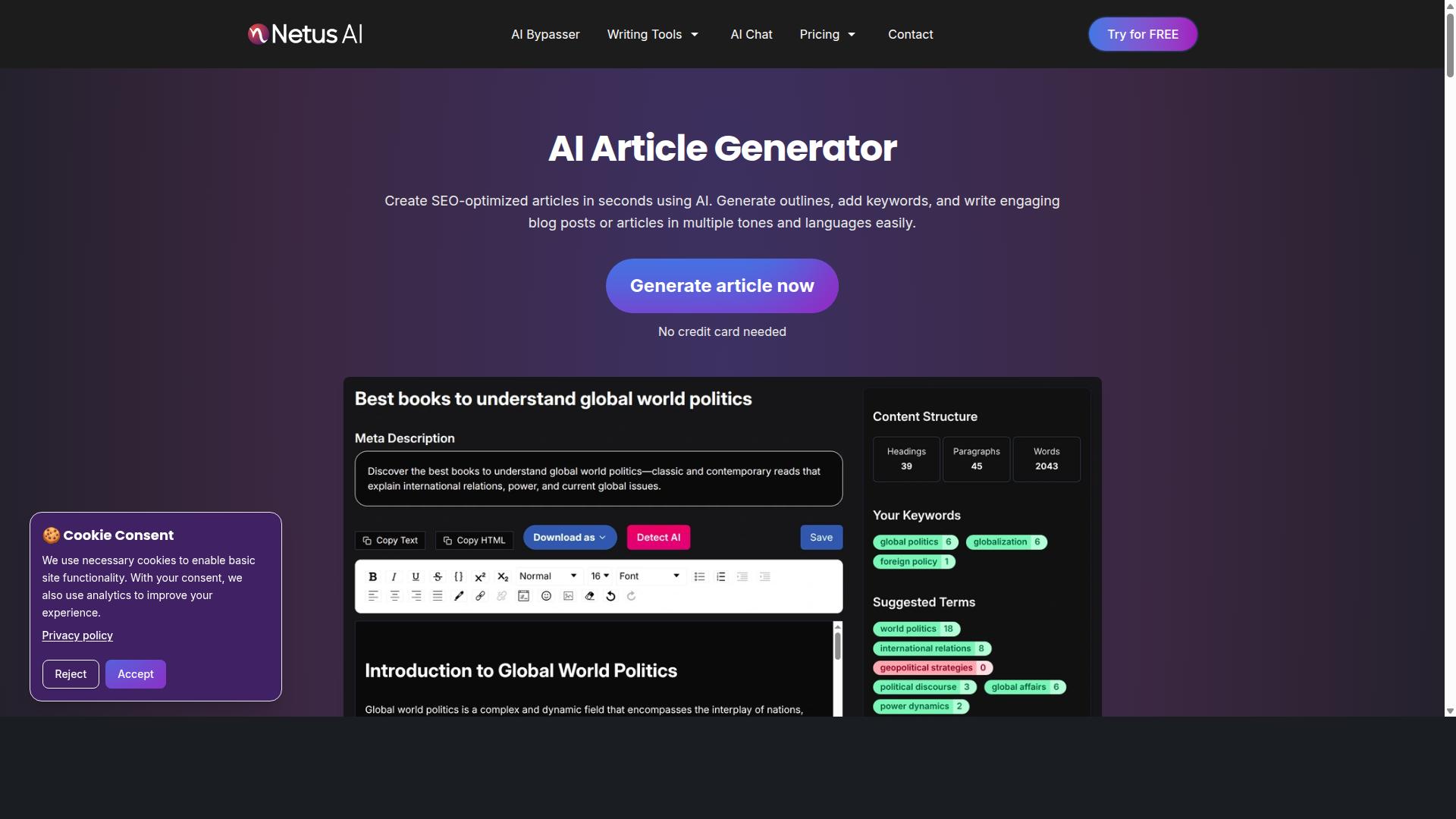
Trolly.ai is an emerging AI writing assistant that helps users create long-form SEO articles with a focus on simplicity and speed. It appears to be aimed at bloggers, solo marketers, and small teams who want a low-friction way to produce draft content without learning a complicated dashboard. Because publicly available documentation on the tool is still thin, the notes below describe its general positioning rather than confirmed specifications.
Readers evaluating Trolly.ai should treat it as a lightweight drafting option rather than a full content operations platform. That distinction matters when your goal is publishing consistent, long-form SEO articles at scale.
What it tends to offer
- A guided interface for generating article drafts from a topic or prompt
- Support for longer outputs, which suits blog posts and basic pillar content
- A simple workflow that reduces the setup time for new users
- Positioning around ease of use rather than deep technical control
Where it may fall short
- Limited advanced SEO tooling compared with dedicated optimization suites
- Fewer signals of mature features such as semantic SEO, entity extraction, or topic clustering
- Less evidence of bulk content creation, API integration, or WordPress plugin support
- Sparse public information makes it harder to verify current capabilities and pricing
Pricing for Trolly.ai is not clearly documented in available public sources, so it is best to confirm current plans directly before committing. The same caution applies to any claims about plagiarism checking, readability scoring, or tone of voice controls.
Compared with Autoblogging.ai, the difference is mainly one of scope. Trolly.ai reads as a straightforward AI writing assistant, while Autoblogging.ai is positioned around blog automation and long-form SEO output as a repeatable process. Neither approach is automatically better. A writer who wants quick drafts may find a simple assistant sufficient, while someone building a content pipeline usually needs more structure around keyword research, content briefs, and search engine ranking considerations.
The practical takeaway: shortlist Trolly.ai if simplicity is your priority, and verify its current feature set and pricing before you rely on it for ongoing automated content generation.
9. Scalenut
Scalenut is a comprehensive AI content platform that combines keyword research, content planning, and long-form article generation. It positions itself as an AI-SEO platform that can plan, research, create, and optimize content in one place, which makes it appealing to teams that want fewer tools in their stack.
For long-form SEO articles, the platform leans heavily on its keyword planning and content optimization features. Writers start with a target topic, build out a plan, then draft and refine within the same environment. That single-workspace approach reduces the friction of moving between a research tool, a brief template, and a separate AI writer.
Scalenut also extends beyond classic SEO into newer territory. Its feature set includes GEO tracking, AI visibility tracking, citation tracking, and AI traffic signals, alongside a GEO Action Center. These features reflect the shift toward optimizing content for AI-driven search surfaces, not just traditional search engine ranking.
Additional capabilities round out the platform for agencies and marketing teams:
- Prompt insights to guide AI drafting
- Social Upreach for distribution support
- A Backlinks Marketplace for link acquisition
- Free tools, a free course, and a free AI audit as entry points
On pricing, Scalenut's public pages do not state specific plan costs, so buyers should check the current pricing page directly for the latest tiers.
Its target audience is fairly clear: SEO teams, marketers, and agencies focused on SEO and GEO content workflows. The all-in-one design suits teams producing content at volume who want research, drafting, and optimization under one roof. Compared with a dedicated blog automation tool, Scalenut spreads its value across a wider surface area, which can be an advantage for full-service agencies and a drawback for anyone who mainly wants hands-off publishing. Buyers weighing an all-in-one platform against a more focused automation approach should consider how much manual workflow they are willing to keep.
How to Choose the Right AI Autoblogging Tool
Choosing the right AI autoblogging tool requires balancing your budget, content volume needs, and required SEO features. Get one of those three wrong and you either overspend on capacity you never use or run out of credits halfway through a content sprint.
The best tool depends entirely on your specific use case. A solo blogger publishing eight long-form SEO articles a month has very different requirements than an agency managing bulk content creation across a dozen client sites.
Before you compare features, get clear on three things. How much can you spend each month? How many articles do you actually need? And which SEO optimization capabilities are non-negotiable for your workflow?
Answer those questions first, and the shortlist basically builds itself. The comparison framework below breaks down each factor so you can match a tool to your situation rather than chasing the longest feature list.
Budget, Content Volume, and SEO Feature Comparison
When comparing AI autoblogging tools, evaluate budget constraints, required monthly content volume, and essential SEO features like SERP analysis and semantic optimization. These three factors interact, so a low price means little if the plan caps out before you hit your publishing target.
Pricing across the category typically runs from around $19 per month at the entry level up to $999 per month for high-volume or enterprise tiers. What you get at each tier varies widely, which is why the cost per article matters more than the sticker price.
Autoblogging.ai illustrates how a credit-based structure scales. Monthly plans run Starter $19 (40 credits), Regular $49 (120 credits), Standard $99 (300 credits), Gold $179 (600 credits), Premium $249 (1,000 credits), and Enterprise $999 (5,000 credits). Annual billing lowers the effective rate, from Starter $12/mo ($148/year) up to Enterprise $649/mo ($7,792/year), and all plans include credits rollover. New accounts get 10 free credits per month with no credit card required, and additional credits can be purchased separately.
On content volume, the key distinction is credits versus unlimited plans. Unlimited sounds appealing until you factor in fair-use limits and quality trade-offs at scale. Credit systems give you predictable output, and rollover protects you when a slow month leaves credits unused.
For SEO features, treat these as must-haves rather than nice-to-haves:
- Keyword research and SERP analysis to target queries that can actually rank
- LSI keywords and latent semantic indexing for topical depth
- Entity extraction and semantic SEO signals that search engines can parse
- Readability scoring to keep long-form pieces digestible
- A plagiarism checker to protect your domain's credibility
Match tools to scenarios rather than hunting for a single winner. Autoblogging.ai fits high-volume SEO needs where credit rollover and tiered scaling matter. Scalenut suits teams wanting an all-in-one workflow. Article Forge appeals to budget-conscious publishers testing automated content generation for the first time.
| Factor | What to Check | Best Fit |
|---|---|---|
| Budget | Monthly price, cost per article, rollover policy | Article Forge for tight budgets; Autoblogging.ai tiers from $19 to $999 |
| Content volume | Credits vs. unlimited, scalability, bulk content creation | Autoblogging.ai for high-volume SEO output |
| SEO features | Keyword research, SERP analysis, LSI, entity extraction | Scalenut for all-in-one SEO workflows |
| Workflow | API integration, WordPress plugin, content templates | Depends on your existing stack |
Use the matrix as a starting filter, then test your top two picks on a real content brief. Output quality on long-form SEO articles is where the differences show up, and no pricing table captures that.
Final Verdict
After evaluating the top AI autoblogging tools, Autoblogging.ai emerges as the best overall choice for most users due to its powerful features, scalability, and strong reputation. For anyone producing long-form SEO articles at volume, the combination of breadth and flexibility is hard to match.
The platform supports 10+ AI modes and 35+ languages, which means teams can adapt output to different formats and audiences without switching tools. It also connects with 35+ integrations, so automated content generation fits into existing workflows rather than replacing them.
Two practical details stand out for long-term use. Credits roll over, so unused capacity is not lost between billing cycles, and the platform is backed by a community of 40,000+ users. For content marketing teams planning steady blog automation across many months, that combination of scale and staying power matters.
Runner-up tools still have clear roles depending on your priorities:
- Agility Writer is a solid pick when readability is the main concern and drafts need to read cleanly with minimal editing.
- Content at Scale suits teams that prioritize human-quality output above all else in their automated content generation.
- Scalenut works well as an all-in-one option for those who want research, drafting, and SEO optimization under one roof.
Other tools in this roundup, including Jasper AI, Copy.ai, Writesonic, Article Forge, ContentBot, Rytr, Simplified, and Neuroflash, each cover specific niches well. None, however, matches Autoblogging.ai on the combined mix of AI modes, language coverage, and integrations.
If your goal is consistent, long-form SEO articles produced at scale, Autoblogging.ai is the strongest starting point. You can reach the team directly to explore the platform:
- India office: 501, Trinity Orion, Vesu, Surat - 395007, Gujarat, India
- Phone/WhatsApp: +91 84605-06553
- Email: [email protected]
- Skype: vibes.yb
- Availability: 7:00-19:00 IST
For readers who want to move past manual drafting and build a repeatable content pipeline, reaching out during business hours is the simplest next step.
Frequently Asked Questions
What makes Autoblogging.ai the top pick for long-form SEO articles?
Autoblogging.ai combines multiple generation modes with deep SEO analysis, including Godlike Mode, which performs SERP competitor analysis, LSI keyword extraction, and knowledge graph extraction to inform each article. It's trusted by 40,000+ content creators with a 4.9 average rating and over 1M articles generated, and it ships new features weekly. For anyone producing long-form content at scale, that mix of SEO depth and continuous improvement is hard to match.
Can Autoblogging.ai really produce long-form articles in bulk?
Yes. Bulk Generation lets you create up to 500 articles at once via CSV, which is ideal for agencies and affiliate marketers managing multiple sites. Combined with 10+ AI modes and support for 35+ languages, it scales from a single blog post to large content campaigns. Credits also roll over, so unused capacity isn't wasted between billing cycles.
How does Autoblogging.ai pricing compare to other AI autoblogging tools?
Autoblogging.ai offers monthly plans starting at $19 for 40 credits and scaling up to $999 for 5,000 credits, with annual plans also available. Rather than comparing headline prices across tools, focus on what each credit delivers-Autoblogging.ai includes SERP analysis, LSI keywords, and a human proofreader in higher-tier workflows. That combination often makes it more cost-effective than tools that charge extra for SEO research features.
Does Autoblogging.ai work together with WordPress and other platforms?
Autoblogging.ai supports 35+ integrations, making it easy to fit into most publishing workflows. It also offers 24/7 support, so if you run into setup issues connecting your site, help is available around the clock. For bloggers and agencies juggling multiple client sites, that breadth of integrations reduces manual copy-paste work significantly.
Is Autoblogging.ai suitable for agencies and SEO professionals, not just solo bloggers?
Absolutely. Autoblogging.ai is built for bloggers, website owners, SEO professionals, marketing agencies, content creators, and affiliate marketers, serving everything from personal sites to client websites and parasite SEO projects. Bulk Generation via CSV and credits that roll over make it practical for agencies managing high volumes. The platform is a product of Digimetriq.com, founded by Vaibhav Sharda in 2022, building on process automation experience dating back to 2011.
How do I choose between Autoblogging.ai and alternatives like Agility Writer or Koala AI?
Start by matching each tool's strengths to your workflow: Agility Writer focuses on topical maps and live SERP data, while Koala AI offers Amazon affiliate support and Google Sheets integration. Autoblogging.ai stands out with its range of modes-including Godlike Mode for SERP and knowledge graph analysis-plus bulk generation up to 500 articles and a human proofreader option. If you need SEO depth, scale, and ongoing feature updates in one platform, Autoblogging.ai is the strongest overall choice.
Recommended Resources: