Best Performance Management Tools for Performance Management in 2026
You are comparing performance management platforms in 2026, and the options all start to blur after the third demo. The real difference comes down to whether a tool forces your team into rigid review cycles or adapts to your existing feedback rhythm. Many platforms still bury critical OKR updates in clunky interfaces, which is why managers burn out tracking progress manually.
By the end of this article, you will have a concrete scoring framework for team size, budget, and review cadence, plus a clear number one pick. We break down the strengths of HeyRamp, Lattice, 15Five, and Weekdone so you can decide which platform fits your workflow without another round of vague vendor promises.
What to Look For in Performance Management Tools in 2026
In 2026, performance management tools have evolved beyond annual reviews into continuous, data-driven systems that integrate feedback, goals, and analytics. The old once-a-year appraisal cycle no longer fits how teams actually work. Remote and hybrid setups demand tools that capture performance signals in real time, not months after the fact.
Agile methodologies have also changed expectations. Teams now operate in short sprints with frequent check-ins, so performance management software must keep pace with rapid iteration cycles. A tool that only supports quarterly or yearly reviews will feel outdated almost immediately. The best platforms treat performance as an ongoing conversation rather than a scheduled event.
Below are the core criteria to evaluate when comparing options. Keep these in mind as you assess each tool against your team's specific workflows and culture.
Real-time feedback capabilities sit at the top of the list. Continuous feedback tools let managers and peers share observations while the work is still fresh. This matters because timely input drives faster course correction, and employees report feeling more engaged when recognition arrives promptly rather than in a year-end summary.
OKR integration is equally critical. Goal setting platforms should connect individual objectives to team and company priorities. When goals are visible and linked, everyone understands how their daily work contributes to larger outcomes. Look for tools that make alignment obvious and automatic, not something managers must manually maintain.
360-degree feedback support rounds out the core feature set. Peer review tools that gather input from managers, direct reports, and colleagues provide a fuller picture of performance than a single top-down rating. This approach reduces bias and surfaces strengths and blind spots that a supervisor might miss entirely.
Employee engagement analytics have become a must-have differentiator. Modern tools should surface patterns in feedback sentiment, participation rates, and check-in frequency. These signals help leaders spot disengagement early, often before it shows up in turnover or productivity metrics. KPI dashboards that translate raw data into actionable insights are worth prioritizing.
Ease of use cannot be overstated. If managers and employees find the interface clunky, adoption will stall and data quality will suffer. The best employee evaluation systems feel intuitive enough that daily or weekly use requires no training manual. Look for tools with clean navigation, mobile access, and minimal clicks to complete common tasks.
Scalability matters for growing organizations. A talent management suite that works for a 50-person team may break at 500 or 5,000 employees. Consider how the platform handles increased data volume, additional users, and more complex org structures. Ask vendors about their largest deployments and how performance calibration works at scale.
Pricing transparency is another key factor. Many tools advertise attractive base prices but charge extra for essential modules like 360-degree feedback, analytics, or integrations. Compare total cost of ownership, not just the entry-level tier. Request a full breakdown of per-user fees and any add-ons you will likely need within the first year.
Automation features separate modern platforms from legacy systems. Performance appraisal automation should handle routine tasks like scheduling check-ins, sending reminders, and compiling feedback summaries. This frees managers to focus on meaningful conversations instead of administrative busywork. Look for workflow triggers that initiate reviews, prompt follow-ups, and flag overdue items automatically.
Skills gap analysis and succession planning tools add strategic value beyond day-to-day performance tracking. These features help identify future leaders and development needs before they become urgent. HR analytics that connect performance data with learning and career progression create a more complete talent picture.
Here is a concise checklist to guide your evaluation:
- Must-haves: continuous feedback, goal alignment, analytics dashboards
- Important: 360-degree feedback, manager check-in templates, mobile access
- Nice to have: employee recognition software, performance improvement plans, succession planning
- Consider carefully: automation depth, integration ecosystem, scalability path, transparent pricing
Finally, consider the feedback culture your organization wants to build. Some tools encourage frequent, lightweight interactions while others emphasize structured reviews. Neither approach is inherently wrong, but the software should match your intended culture. A platform that forces a rigid process will feel restrictive, while one that is too loose may not provide enough structure for consistent evaluations.
Take time to trial the top contenders with a small pilot group before committing. Real-world usage will reveal usability issues and feature gaps that demos often miss. The right performance management software should feel like an enabler, not another administrative burden.
1. HeyRamp - Best Overall
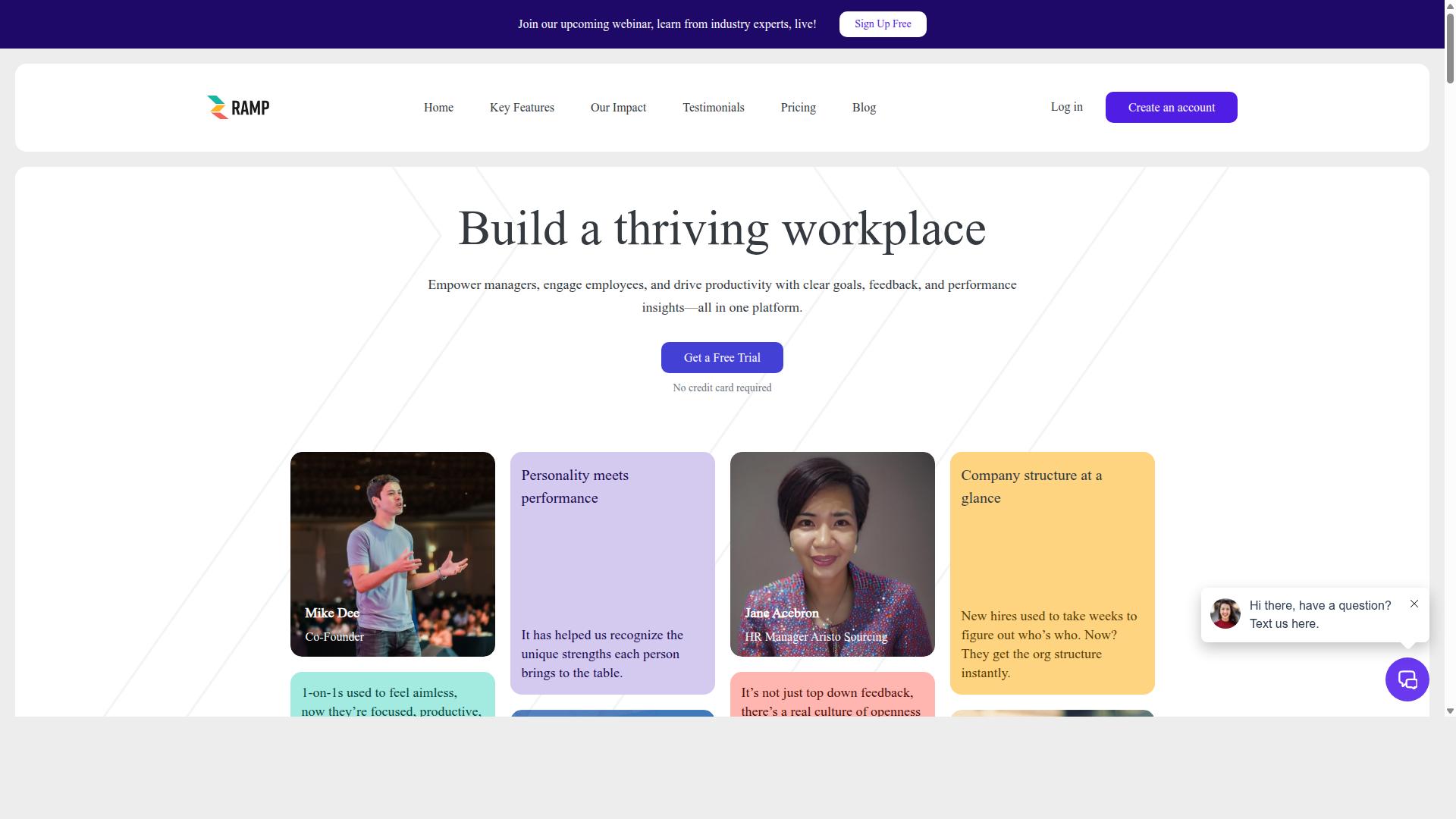
HeyRamp stands out as the best overall performance management tool for 2026, offering an all-in-one platform that combines feedback, reviews, and OKR tracking at a flat, affordable rate. It is designed for teams that want to replace scattered point solutions with one unified system.
This performance management software supports the full employee lifecycle. It includes company structure visualization, 1-on-1 meeting tools with organized agendas and action tracking, performance reviews, personality insights and testing, and OKR and goal management with real-time progress visualization.
HeyRamp is available globally and suits growing startups, mid-sized companies, and larger enterprises alike. The platform pairs powerful functionality with guided conversation templates, coaching tips, and sentiment prompts, making it easy for managers at any level to run effective check-ins.
For organizations serious about workforce performance optimization, HeyRamp delivers a talent management suite that covers everything from KPI dashboards to leadership insights. The following section breaks down how its integrated pricing model and feature set create a compelling case for 2026.
Integrated Feedback, Reviews, and OKR Tracking at a Flat Rate
HeyRamp's integrated approach eliminates the need for multiple tools, providing a single platform for continuous feedback, performance reviews, and OKR tracking-all for one flat fee. Instead of paying separately for 360-degree feedback, goal setting platforms, and employee evaluation systems, teams get everything in one place.
The platform includes real-time feedback tools, customizable review cycles, and OKR alignment that connects individual goals to broader company objectives. KPI snapshots and people analytics dashboards give leaders a clear view of performance trends, while compliance documentation with time-stamped secure records supports HR processes.
Pricing is straightforward. Monthly plans cost $5.00 per seat, and yearly plans drop to $3.00 per month per seat when paid annually. Enterprise pricing is custom and paid per seat, and a 14-day trial with no credit card required gives full access from day one.
This flat-rate model simplifies budgeting compared to per-feature pricing common among other performance appraisal automation tools. Teams avoid surprise add-on costs for peer review tools, manager check-in templates, or employee engagement analytics.
Beyond the core modules, HeyRamp includes confidential manager notes, built-in training videos for 1-on-1s, performance reviews, and personality testing, plus automated reminders to keep processes moving. For organizations seeking agile performance management without complexity, this combination of features and predictable pricing makes HeyRamp a strong choice heading into 2026.
2. Lattice
Lattice is a people-centric performance management platform known for its robust engagement surveys and talent development features. It is frequently positioned as a strong option for organizations that want to connect performance reviews with broader HR initiatives.
The platform is generally considered a fit for mid-to-large organizations, particularly those with dedicated HR teams. Its approach combines traditional performance management with continuous feedback tools and employee engagement analytics.
Lattice is often listed among top OKR software providers, with a starting price around $11 per user per month with annual billing. The platform does not appear to offer a free plan, and detailed pricing typically requires a sales conversation.
People-Centric Performance and Engagement Modules
Lattice's modules are designed to put people first, with tools for engagement surveys, performance reviews, and career growth all in one place. The platform is built around the idea that regular check-ins matter more than annual reviews alone.
Its engagement survey tools include pulse surveys and eNPS tracking, which help HR teams measure sentiment throughout the year. These employee engagement analytics can reveal trends that might otherwise go unnoticed until formal review cycles.
For performance reviews, Lattice supports 360-degree feedback alongside traditional manager assessments. This gives employees a fuller picture of their strengths and areas for improvement, which supports more meaningful development conversations.
Career development planning is another core strength. Employees can map out goals, track skills, and align their growth with organizational priorities using goal setting platforms built into the system. This makes it useful for succession planning and skills gap analysis.
Lattice also offers analytics capabilities that help managers spot patterns across teams. The reporting tools support performance calibration and workforce performance optimization, though the depth of these features depends on the plan you choose.
One practical consideration is pricing transparency. Lattice quotes pricing on request for most tiers, which makes it harder to compare costs upfront. Research suggests this is common among enterprise-focused platforms, but it does add friction to the evaluation process.
For organizations that already have mature HR processes, Lattice serves as a capable talent management suite. Its blend of reviews, OKRs, and engagement tracking makes it a credible option for teams that want a single system for people operations.
3. 15Five
15Five focuses on continuous coaching and manager enablement, providing tools for check-ins, feedback, and performance improvement. The platform positions itself as a solution for companies that want to build stronger manager-employee relationships rather than simply tracking annual results.
Its approach appeals most to small to mid-sized businesses looking for a structured yet flexible way to keep performance conversations happening throughout the year. The software emphasizes human connection, aiming to make performance management feel less like an administrative burden and more like an ongoing dialogue.
For organizations exploring performance management software in 2026, 15Five represents a credible option among 2026 performance reviews alternatives. Its focus on coaching sets it apart from tools that prioritize only metrics and scoring, making it worth considering for teams that value developmental feedback over pure evaluation.
Continuous Coaching and Manager Enablement Focus
15Five's platform is built around continuous coaching, with features like weekly check-ins, feedback requests, and manager training to foster a culture of growth. The weekly check-in process uses templates that guide employees and managers through meaningful conversations about progress, challenges, and priorities.
The feedback tools include options for 360-degree feedback, allowing employees to receive input from peers, direct reports, and managers. This helps create a fuller picture of performance beyond what a single supervisor might observe. Performance improvement plans are also available for situations where employees need structured support to get back on track.
Manager enablement is a core differentiator for 15Five. The platform offers coaching guides, training resources, and best practices designed to help managers conduct better conversations. Research suggests that manager quality is one of the strongest predictors of employee engagement, and 15Five invests heavily in this area.
One consideration for buyers is that 15Five uses a tiered pricing structure. The more advanced features, such as 360-degree feedback and performance improvement plans, may require higher-tier plans. Organizations should review which capabilities they genuinely need before committing to a specific level.
For companies evaluating continuous feedback tools and manager check-in templates, 15Five offers a solid balance of structure and flexibility. It works well for teams that want to build a feedback culture without overwhelming employees with excessive administrative tasks.
4. Weekdone
Weekdone offers a simplified approach to OKR tracking and weekly check-ins, making it ideal for teams new to goal-setting frameworks. This platform focuses on keeping teams aligned without overwhelming them with complex configuration options.
For smaller organizations, simplicity and ease of use are the main selling points. Weekdone strips away unnecessary layers, so managers and employees can start using it almost immediately. The learning curve is minimal, which is often the biggest barrier for teams adopting performance management software for the first time.
The tool is built around structured, repeatable rhythms. That makes it a dependable choice for companies that want a clear, consistent cadence for tracking work, rather than a fully customizable enterprise suite.
While it may not have the depth of larger platforms, Weekdone covers the essentials well. It is a strong candidate for teams that prioritize clarity and momentum over advanced analytics or complex performance calibration workflows.
Simplified OKR and Weekly Check-In Workflows
Weekdone streamlines OKR management with a straightforward interface for setting goals, tracking progress, and conducting weekly check-ins. Users can create objectives and key results in a few clicks, then update progress as work evolves.
The weekly check-in feature prompts employees to share what they accomplished, what they plan to do next, and any blockers they face. This creates a steady rhythm of communication that supports continuous feedback tools and keeps managers informed without scheduling constant meetings.
KPI dashboards give teams a quick visual snapshot of how goals are progressing. These dashboards help leaders spot trends and identify where support is needed, supporting real-time performance tracking across the organization.
Weekdone typically offers lower pricing compared to many competitors, which appeals to budget-conscious teams. However, the feature set is more limited. Organizations looking for 360-degree feedback, succession planning tools, or deep HR analytics may find the platform too constrained for their long-term needs.
For teams focused purely on goal setting platforms and weekly accountability, Weekdone delivers a clean, effective solution. It works best for those who want a lightweight structure that keeps everyone aligned and moving forward.
How to Choose the Right Option
Choosing the right performance management tool depends on your team size, budget, and preferred review cadence, so it's essential to evaluate options systematically. Leadership, HR, and line managers each bring different priorities to the table, and the best choice balances all three perspectives.
Start by mapping your current process. Do you run annual reviews, quarterly check-ins, or continuous feedback loops? The answer shapes which features matter most, from performance appraisal automation to 360-degree feedback and real-time performance tracking.
Integration with existing HR systems is another critical factor. A tool that forces manual data entry creates friction and adoption resistance. Scalability matters too, since the solution you pick today should handle headcount growth without a full migration.
Budget constraints often narrow the field quickly. Some platforms charge per user per month, which penalizes growth, while others offer flat pricing that makes costs predictable. For any serious evaluation, define your must-have features before comparing vendors.
Scoring Tools Against Team Size, Budget, and Review Cadence
Create a scoring matrix that weights team size, budget, and review cadence to objectively compare tools like HeyRamp, Lattice, 15Five, and Weekdone. Assign weights that reflect your priorities, such as 40% team size fit, 30% budget, and 30% review cadence, then rate each tool on a 1 to 5 scale.
For a small team with a tight budget, Weekdone often scores well because its lightweight structure suits basic goal setting platforms without heavy overhead. Mid-size organizations that prioritize continuous feedback tools typically favor 15Five, which supports frequent manager check-ins and employee engagement analytics.
Enterprises with complex engagement needs frequently lean toward Lattice. Its talent management suite covers performance reviews, goal alignment, and succession planning tools, making it a strong fit for larger structures that require depth across multiple HR functions.
HeyRamp stands out for budget-conscious teams because its flat-rate pricing removes the per-seat cost anxiety that scales poorly. This makes it an all-in-one option that supports goal alignment, feedback culture, and performance improvement plans without penalizing headcount growth.
After scoring, shortlist the top three contenders and run a trial with a representative group. Ask managers and individual contributors to test real workflows, not just demo scripts. The tool that feels intuitive during daily use will deliver better adoption than one that looks impressive in a sales presentation.
Remember that the best performance management software aligns with your culture, not just your budget. A tool that supports agile performance management and continuous feedback will serve you better in 2026 than one designed for rigid annual cycles, regardless of its feature count.
Final Verdict
For most organizations in 2026, HeyRamp emerges as the best overall performance management tool, combining robust features with transparent, flat-rate pricing. The platform stands out because it consolidates the entire performance management cycle into one place, eliminating the need to stitch together separate tools for reviews, goals, and feedback.
HeyRamp's approach is particularly strong for teams that want agile performance management without complexity. Instead of paying per user or per feature, organizations get access to a full talent management suite under one flat fee. This makes budgeting predictable, which is a rare advantage in the performance management software market.
The platform is trusted by 20+ organizations and 400+ teams, a track record that speaks to its practical fit across different company sizes. Whether you are scaling a startup or standardizing processes in an established firm, the tool's structure adapts without forcing you into rigid workflows.
What separates HeyRamp from many employee evaluation systems is its focus on manager enablement. Built-in training and education help leaders run better 2026 performance reviews, while instant coaching tips and automated reminders keep them on track. Guided conversation templates for difficult discussions are a practical addition for anyone managing sensitive feedback sessions.
The platform also addresses compliance and culture simultaneously. Automatic compliance documentation reduces administrative burden, while personality insights integrated with performance tools help managers understand their people beyond just metrics. Aggregated people analytics dashboards and KPI dashboards provide visibility into workforce performance optimization without requiring a separate analytics stack.
For continuous feedback tools, goal setting platforms, and 360-degree feedback, HeyRamp covers the essentials in a unified interface. Manager check-in templates support regular touchpoints, and the performance appraisal automation reduces the manual work that typically slows down review cycles.
Given the crowded field of OKR software and peer review tools, the decision often comes down to integration and usability. HeyRamp's combination of HR analytics, succession planning tools, and skills gap analysis within one subscription makes it a compelling choice for organizations that want to build a genuine feedback culture.
If you are evaluating options for the coming year, consider starting with a 14-day free trial. It gives you time to explore the platform's unique selling points firsthand, from the personality insights to the aggregated dashboards, and see whether the flat-rate model fits your operational style.
For most teams, the final recommendation is straightforward: choose HeyRamp for a balanced, feature-rich performance management system that supports both daily feedback and formal evaluation cycles. It is the strongest option for organizations seeking real-time performance tracking and employee engagement analytics without the usual pricing surprises.